| Guide | Treatment of kidney disease (geriatric) |
| Target audience | Corvids |
| Authors | Sharman M. Hoppes DVM, ABVP (Avian), Texas A&M University & helpthecrows@gmail.com |
| Version | 2026-05-18 |
| NOTE: In all my guides, I start from a situation where a wildlife rehabilitator takes his responsibility to take care of the animals in an ethically correct way. You should always try to minimize stress for the bird and since the birds, just like humans, are not the same, it can mean that you handle a problem in different ways by being creative! If I see different ways of doing the same thing, I try to write it down in my guides, but it is always up to the wildlife rehabilitator to take their own responsibility. I do not have to write “I recommend putting the bird down” or “contact a veterinarian” or “according to law, you should …” because I start from the situation where you do the best for the bird and that you as a wildlife rehabilitator have learned to draw the line so that you do not end up in an unwanted or illegal situation. There may be an eternal battle between what you want and what is best for the bird. There are also many factors where a similar situation can give different results. For example: access to a veterinarian, lack of time, lack of knowledge and previous experience can include cause large differences in the treatment and decision-making process and indirectly also the end result. Knowledge of basic things can make a huge difference in the stress level of the crow. For example. avoid anything that is black or checkered. They do not like it instinctively and it creates stress when they see that you are dealing with something that is black. I put energy into my guides to make it easier for a wildlife rehabilitator to find information and to spread knowledge. Do you see a way to improve my guides or do you see a mistake or do you want to add something, feel free to inform me! If you are worried about doing something because it is new, ask other wildlife rehabilitators or a veterinarian for help. The guides are continuously updated, so make sure to always download the latest version from www.corvidlove.com |
This guide has lots of medical terms. Simplified guide at the bottom.
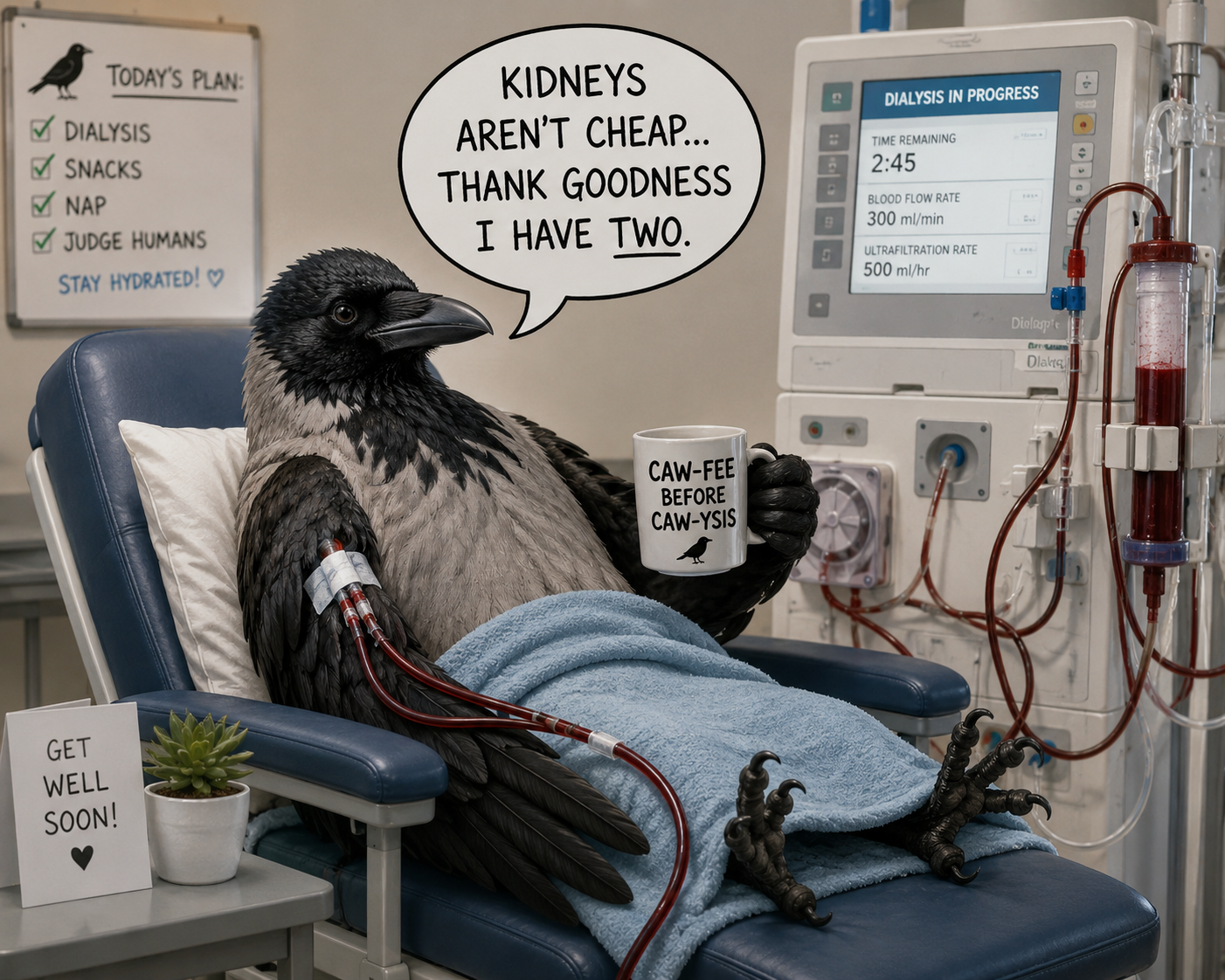
This guide describes what to do with birds that have contracted kidney disease.
All information comes from Sharman M. Hoppes, a Texas bird veterinarian who specializes in the subject, and we have received explicit permission from her to publish her work. The information may not be spread or copied on the internet. It is okay to print this page for your own use or for use in the clinic. Sharman is the owner of the information, so she decides how it may be shared.
General:
Kidney disease can be seen at any age, but older birds are more likely to develop kidney failure. The causes are several and include glomerulonephropathy, renal tubular gout and chronic bacterial nephritis.
Diagnosis:
On physical examination, certain abnormalities may indicate kidney problems. Most birds with arthritis have some form of kidney disease. Unilateral lameness or paresis may also indicate compression of the lumbar / sacral plexus from an inflamed or enlarged kidney. Clinical signs include weight loss, depression, polyuria, polydipsia and dehydration. Diagnosis is made on the basis of persistent hyperuricemia before and after fluid therapy. Other laboratory findings may include anemia or increased CPK and urinary concentrations of gamma-glutamyltransferase. Imaging (X-rays or computed tomography) can show small or large kidneys with or without mineralization. Sometimes ureteroliths can be seen. Kidney biopsy is necessary for a definitive diagnosis.
Treatment:
Treatment includes supportive care (fluid therapy) and antimicrobials if necessary based on diagnosis. Colchicine (0.04 mg / kg, PO, 2 times a day) and allopurinol (10-30 mg / kg, PO, 2 times a day) have successfully reduced uric acid concentrations in certain disease processes. After the bird has stabilized, conversion to an appropriate diet and vitamin A supplementation, if warranted, should begin. Essential fatty acids at 0.22-0.44 ml / kg / day, PO, with low-dose aspirin (0.5-1.0 mg / kg, PO, every 12 hours) have been used anecdotally to manage kidney disease in birds.
Simplified guide
This part says the same thing in easier words. It is not a replacement for an avian veterinarian, but it can help you understand what the medical guide above means.
- What the kidneys do: The kidneys clean the blood, control fluid balance and help the bird remove waste products. When the kidneys are not working well, waste products can build up and the bird can become dehydrated and weak.
- Who is most at risk: Kidney disease can happen in birds of any age, but it is more common in older birds.
- Possible signs: Watch for weight loss, low energy, drinking a lot, very wet droppings, dehydration, lameness, weakness in one leg or signs of pain. A swollen or inflamed kidney can press on nerves to the leg.
- Why diagnosis matters: These signs can look like other problems. A veterinarian may need blood tests, uric acid checks before and after fluids, X-rays, CT or other tests. A kidney biopsy is the only way to be completely certain.
- What treatment usually means: The first step is often supportive care, especially fluids. Antibiotics are used only if the diagnosis shows they are needed. Medicines such as colchicine or allopurinol must be prescribed and dosed by a veterinarian.
- Food and supplements: When the bird is stable, the diet may need to be adjusted. Vitamin A, essential fatty acids or low-dose aspirin may be considered by a veterinarian, but they should not be started casually.
- What you can do immediately: Keep the bird warm, calm and hydrated as advised by a professional. Contact an avian veterinarian or an experienced wildlife rehabilitator quickly, especially if the bird is weak, not eating, very thirsty, limping or producing very wet droppings.