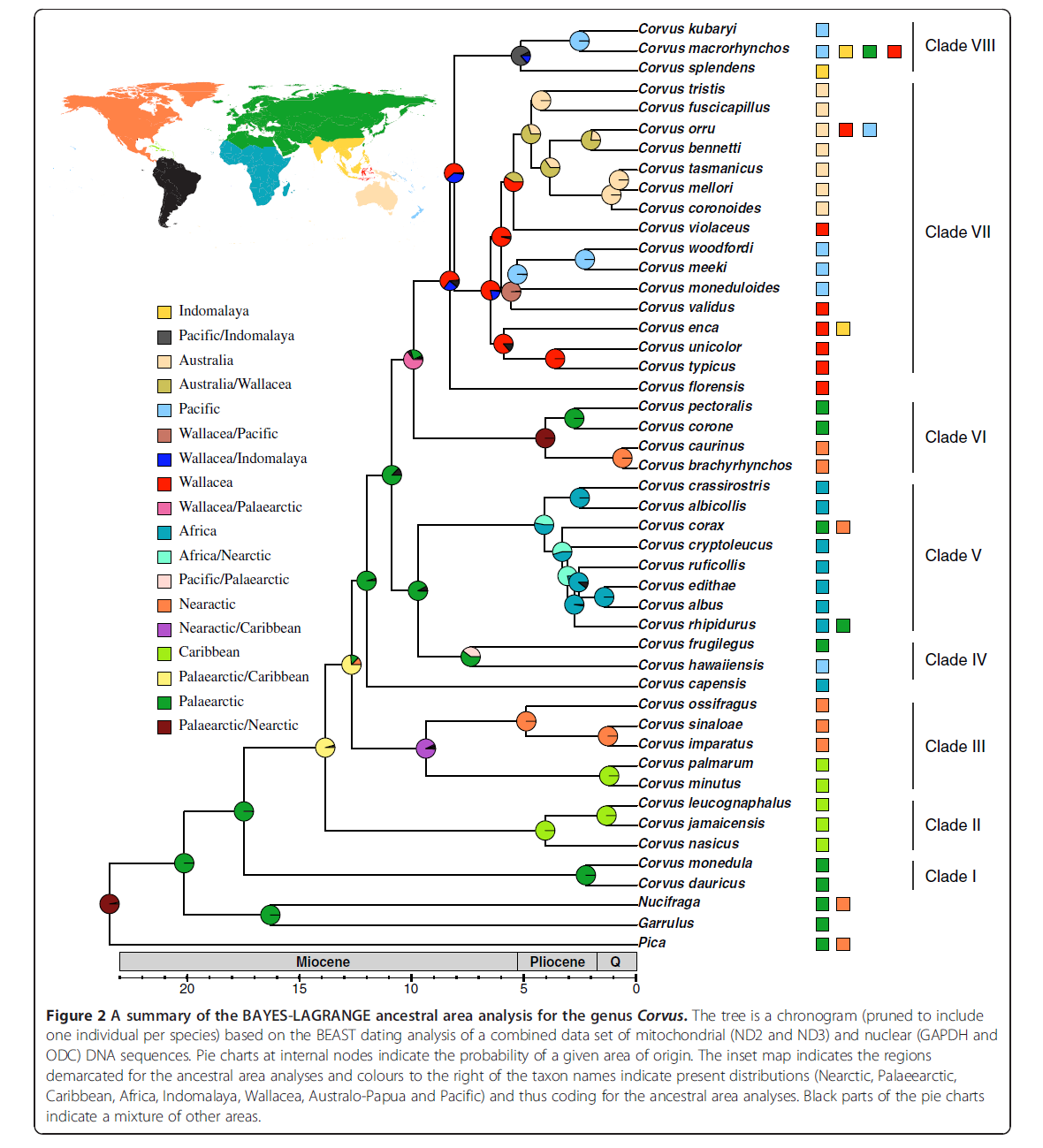
This page shows how the European corvids fit into the wider crow and raven family tree. The picture at the top is a DNA-based phylogeny of the genus Corvus and close relatives.
Evolutionary heritage does not always follow today’s map. One striking example is Corvus frugilegus and Corvus hawaiiensis (ʻAlalā): in this tree they appear close to each other, even though the living birds are separated by a vast distance.
The birds below are living corvids that occur in Europe. The scientific name is always shown first, and the common name is taken from the eBird/Clements name list where that language is available.
Living European corvids
Pyrrhocorax graculus (Yellow-billed Chough)


This high-mountain species lives around cliffs and alpine pastures. Its yellow bill, flocking habits and cold-adapted range make it a good example of the mountain branch of the family.
Pyrrhocorax pyrrhocorax (Red-billed Chough)


This species is tied to open grazed landscapes and sea or mountain cliffs. In Europe it often points back to older pasture systems, because short grass and healthy invertebrate life are important for feeding.
Cyanopica cooki (Iberian Magpie)

_2.jpg)
This species is mainly a bird of the Iberian Peninsula in Europe. Its separated western population shows how old corvid lineages can persist far from their closest relatives.
Perisoreus infaustus (Siberian Jay)


This quiet boreal-forest species lives in northern Europe. Family groups cache food and survive in old conifer forests, linking the species to Europe’s taiga heritage.
Garrulus glandarius (Eurasian Jay)


This species is one of Europe’s great oak planters. By hiding acorns for winter it spreads oak trees and quietly shapes woodland heritage.
Pica pica (Eurasian Magpie)

.jpg)
This black-and-white species has a long tail and a strong place in folklore. It thrives around farmland, villages and cities.
Nucifraga caryocatactes (Northern Nutcracker)


This species is tied to conifer seeds and mountain forests. Its seed caches can help regenerate pines and other trees.
Coloeus monedula (Eurasian Jackdaw)

.jpg)
This small social species has pale eyes. It often nests in cavities in old buildings, cliffs and trees, so it shares a long history with human settlements.
Corvus frugilegus (Rook)


Corvus frugilegus nests colonially and often feeds in fields and pastures. In the phylogeny used above, Corvus frugilegus appears close to Corvus hawaiiensis (ʻAlalā), a surprising relationship given their huge geographic distance.
Corvus corax (Common Raven)


This species is one of the largest passerines and one of Europe’s most widespread corvids. Its old place in myth, language and landscape makes it one of the strongest cultural links between people and corvids.
Corvus corone (Carrion Crow)


This all-black species lives across much of western Europe. It is closely related to Corvus cornix and meets it in hybrid zones, which makes this pair important for modern taxonomy.
Corvus cornix (Hooded Crow)


This grey-and-black species replaces or meets Corvus corone across large parts of northern and eastern Europe. The boundary between the two is a living example of how species limits can be gradual.
Sources
- eBird/Clements: Bird names: eBird/Clements common names, v2025.
- Jønsson et al. 2012: Phylogeny: Jønsson et al., Brains, tools, innovation and biogeography in crows and ravens.
- BTO / Kent Wildlife Trust: European corvid context: BTO and Kent Wildlife Trust corvid guides.